
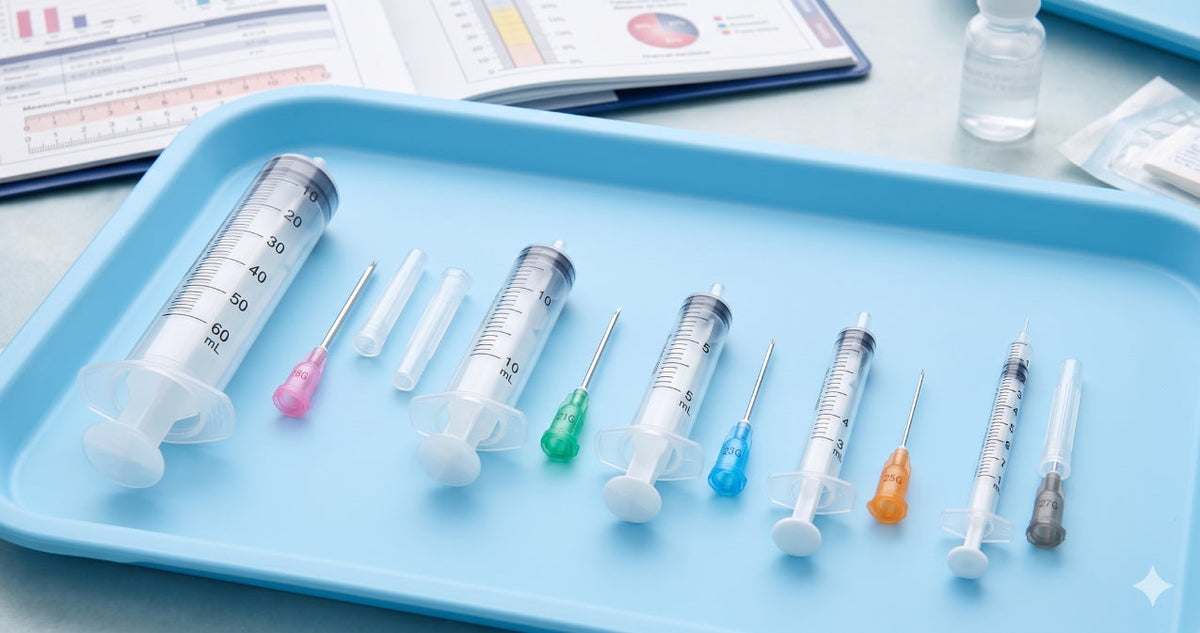
You open your supply box, take out two syringes, and pause. They look similar, but the markings are different. Which details should you compare before reordering? For people managing diabetes, caregivers and home-care nurses, these small differences can be confusing. Knowing what the labels mean makes it easier to compare products and check that an order matches the existing prescription.
Units, not millilitres
Standard U-100 insulin contains 100 units per millilitre. An insulin syringe is marked in units rather than millilitres, so no conversion is needed at the point of use. A 1 mL insulin syringe is therefore marked up to 100 units.
This is why insulin syringes should not be substituted with ordinary syringes, and why the concentration printed on the insulin matters. U-500 insulin is five times more concentrated, so a U-100 syringe would misread it badly. If your insulin is not U-100, the syringe must match it, and that match is specified on the prescription rather than chosen at the point of purchase.
You can browse the site's needles and syringes collection to see the range of products available.
Why barrel size changes precision
Insulin syringes come in three common capacities, and the choice is about readability rather than simply how much they hold.
A 1 mL barrel holds up to 100 units and is usually marked in 2-unit increments. A 0.5 mL barrel holds 50 units and is typically marked in single units. A 0.3 mL barrel holds 30 units and is also marked in single units, spread across a wider scale that is easier to read.
Smaller barrels spread fewer units across the same physical length, so the marks sit further apart. For anyone measuring small amounts, or managing reduced vision, that spacing matters more than total capacity. Good lighting can also make markings easier to distinguish.
Needle gauge and length
Gauge measures the needle's outside diameter, and the scale runs backwards: a higher number means a thinner needle. Insulin syringes commonly use 28 to 31 gauge, at the thin end of the range.
Lengths are short, typically between 4 mm and 12.7 mm, and shorter needles have become the more common default over time. Length is matched to injection technique and body type, and is specified by the prescribing clinician rather than chosen by preference.
What to check when reordering
Match four things against your current packaging: insulin concentration, barrel capacity, needle gauge and needle length. All four are printed on the box.
Confirm the increment marking as well, since two syringes of the same capacity can be marked differently, and that difference is easy to miss on a reorder. Check pack quantity, because these are usually boxed rather than sold singly. If a prescription specifies a particular product, order that product rather than an equivalent.
The site's diabetic supplies collection may also be useful when browsing related products. For clarity, a Covidien 60 cc irrigation syringe with tip is a different product type, not a substitute for an insulin syringe. For another home-care topic, read how to use an incentive spirometer.
Specifications here are general reference only. Syringe selection, dose and injection technique must be directed by the prescribing clinician or diabetes care team.
Disclaimer
This article is provided for general educational purposes only and does not constitute medical advice, diagnosis or treatment. Product information is general and may not suit every individual's circumstances. Always consult a qualified healthcare provider regarding your specific medical needs before changing any aspect of your care.
Published by the Online Medical Supply Team | onlinemedicalsupply.com