
You're finally home.
After days in the hospital, sleeping in your own bed feels like a victory. But along with your discharge papers, medications, and follow-up instructions, there's often one more thing sitting in the bag—a small plastic device your care team told you to use several times a day.
For many people, that device ends up on a bedside table after the first day or two. Not because it seems unimportant, but because recovery is exhausting. Between managing discomfort, resting, and adjusting to life at home, it's easy to forget about a breathing exercise that doesn't appear urgent.
Yet that small device plays an important role in recovery.
An incentive spirometer is designed to help your lungs fully expand after surgery or illness. Consistent use can support healthy breathing, encourage lung expansion, and help reduce the risk of complications that sometimes occur when people spend long periods resting or breathing more shallowly than usual.
If your healthcare team has recommended one, understanding how and why to use it can make the process feel much less intimidating.
If you're wondering how to use an incentive spirometer at home after surgery, the process is simpler than many patients expect.
Important: This article provides general educational information only. Always follow the specific instructions provided by your surgeon, physician, or respiratory therapist. Their guidance should take priority over any general recommendations.
What is an incentive spirometer — and why does it matter after surgery?
After surgery, many people naturally take smaller breaths than usual.
Sometimes it's because of discomfort around an incision. Other times it's because anesthesia, fatigue, or limited movement makes deep breathing feel more difficult.
You can think of the lungs a bit like a balloon. When a balloon stays partially deflated for a long time, it doesn't open as easily as when it's regularly filled with air. Something similar can happen in the lungs during recovery.
Healthcare professionals refer to this as atelectasis, a temporary condition where small portions of the lungs do not fully expand. It is a common and expected part of recovery after many surgical procedures.
The concern is that areas of the lung that aren't fully expanding may not clear secretions as effectively. Over time, this can increase the risk of respiratory complications, including pneumonia.
An incentive spirometer helps address this issue by encouraging slow, deep breaths that fully expand the lungs.
The device provides visual feedback as you inhale. Depending on the model, you'll see a chamber, piston, or indicator rise, showing how deeply you're breathing. This immediate feedback makes it easier to focus on proper technique and track improvement over time.
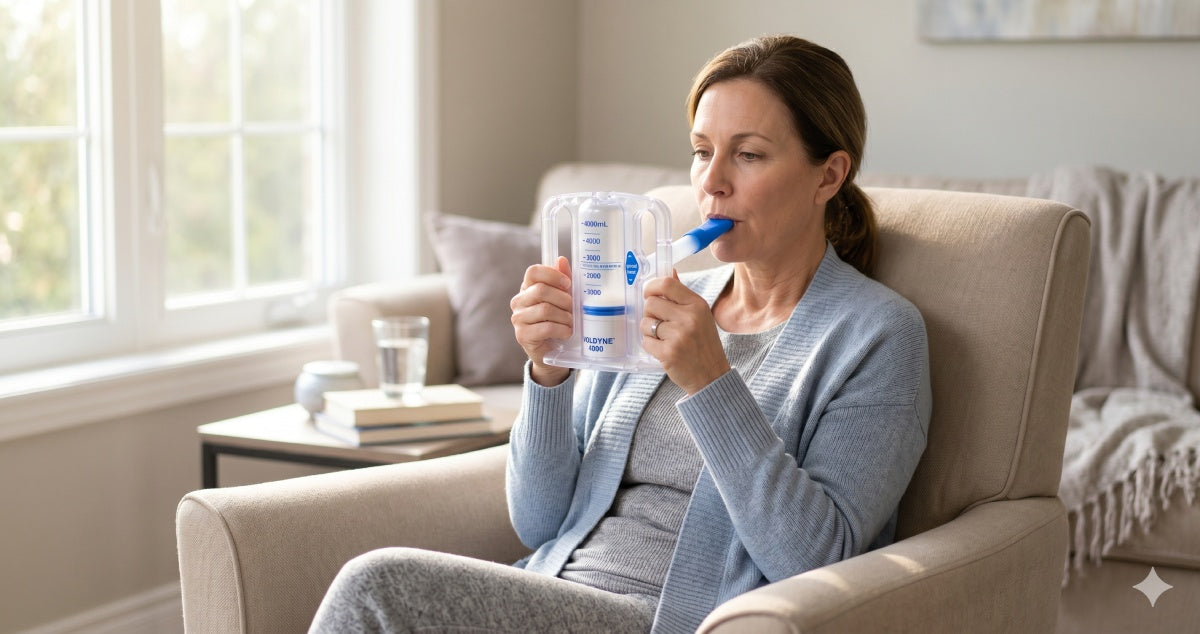
One commonly used option is the Voldyne 4000 Volumetric Exerciser, which is widely used in hospitals and home recovery settings throughout the United States. You can find it at Online Medical Supply here.
It features a large volume chamber, an easy-to-read design, and a flow indicator that helps users maintain proper breathing technique.
Who is typically advised to use an incentive spirometer?
Incentive spirometry is most commonly recommended after procedures that can temporarily affect normal breathing patterns.
Examples include:
- Major abdominal surgeries
- Hip or knee replacement surgery
- Cardiac procedures
- Thoracic or lung surgeries
- Spinal procedures requiring general anesthesia
- Extended periods of bed rest following surgery
Some healthcare providers may also recommend incentive spirometry during recovery from certain respiratory illnesses or infections.
Because every patient's situation is different, the recommendation should always come from a physician, surgeon, respiratory therapist, or another qualified healthcare professional.
An incentive spirometer is not intended as a general wellness device. It is typically used as part of a structured recovery plan.
Step-by-step: how to use your incentive spirometer correctly
The process itself is straightforward, but technique matters.
A few small adjustments can make the exercise significantly more effective.
1. Sit upright: Whenever possible, sit in a chair or position yourself upright in bed.
Good posture allows your lungs to expand more fully and helps you achieve better results.
2. Hold the device upright: Keep the incentive spirometer in a vertical position while using it. This helps ensure accurate readings and allows the indicator to move properly.
3. Exhale normally: Before beginning, take a relaxed breath out. There's no need to force air from your lungs.
4. Seal your lips around the mouthpiece: Place the mouthpiece in your mouth and create a tight seal with your lips. This prevents air from escaping during the exercise.
5. Inhale slowly and deeply: This is the most important step. Rather than taking a quick breath, inhale slowly and steadily. Watch the indicator rise as you breathe in.
The goal is not speed. The goal is controlled lung expansion.
6. Reach your target volume: Your healthcare provider may have given you a target volume. Try to work toward that goal without forcing the breath or creating discomfort.
7. Hold your breath: Once you've inhaled as deeply as possible, hold your breath for approximately three to five seconds. This brief pause gives the lungs time to fully expand.
8. Exhale slowly: Remove the mouthpiece and breathe out normally. Some people find it helpful to exhale through pursed lips, similar to gently blowing out a candle.
9. Rest between repetitions: Take a few normal breaths before beginning the next repetition. Avoid rushing through the exercise.
10. Repeat as directed: Many patients are instructed to perform 10 slow breaths every one to two hours while awake, but schedules vary.
Follow the instructions provided by your healthcare team.
Reading the voldyne 4000 — understanding your goal

Recovery often feels slow because improvements aren't always easy to see. One advantage of the Voldyne 4000 is that it gives you visible feedback each time you use it.
The device measures how much air you inhale during each breath and displays the volume in a clear chamber. Many patients find it encouraging to watch the indicator rise a little higher over time. Even small improvements can be a sign that the lungs are gradually regaining strength and capacity.
Your physician or respiratory therapist may give you a target volume based on your age, height, medical history, and procedure. Don't be discouraged if you cannot reach that number right away. The goal is steady progress, not perfection on day one.
The Voldyne 4000 also includes a flow indicator that helps you maintain a slow, controlled inhale. Remember, a steady breath is usually more effective than a fast one.
Common mistakes that reduce effectiveness
The device is simple, but a few common mistakes can reduce its benefits.
Breathing too quickly: A fast inhale may cause the indicator to rise briefly, but it doesn't provide the sustained lung expansion the exercise is designed to encourage.
Skipping sessions: Consistency matters more than any single session. Using the spirometer regularly throughout the day is generally more beneficial than doing several repetitions at once and then forgetting about it.
Not holding the breath: The brief pause at the top of the inhale allows the lungs additional time to expand. Skipping this step reduces effectiveness.
Stopping because it feels uncomfortable: Mild discomfort is common after surgery, especially near an incision. If you are unsure whether what you're experiencing is normal, discuss it with your healthcare provider rather than abandoning the exercise altogether.
Sharing the device: Incentive spirometers are intended for single-patient use and should not be shared with others.
When to contact your doctor
While an incentive spirometer supports recovery, it does not replace medical supervision.
Contact your healthcare provider if you experience:
- Increasing shortness of breath
- Fever above 100.4°F (38°C)
- Chills or worsening chest discomfort
- Yellow, green, or brown mucus when coughing
- Little improvement after several days of consistent use
- Sudden breathing difficulty or sharp chest pain
These symptoms do not necessarily indicate a serious problem, but they should be evaluated by your care team.
Tips for making incentive spirometry easier to stick with
Like many recovery tasks, the hardest part is often remembering to do it.
A few simple habits can help:
- Set recurring reminders on your phone.
- Keep the device visible rather than storing it in a drawer.
- Use a pillow to support your incision if deep breathing feels uncomfortable.
- Track your daily progress to stay motivated.
- Perform sessions while prescribed pain medication is still providing relief, if appropriate.
Many patients find that turning spirometry into a routine makes it much easier to stay consistent during recovery.
Where to find the voldyne 4000 and respiratory supplies
For nearly 30 years, Online Medical Supply has provided respiratory products and healthcare equipment to patients, caregivers, and healthcare professionals throughout the United States.
Suggested Products:
• 🔗 Voldyne 4000 Volumetric Exerciser — $13.99
• 🔗 Full Respiratory Care Collection
Frequently asked questions
How many times a day should I use my incentive spirometer?
Most patients are instructed to perform 10 deep breaths every 1–2 hours while awake. Follow the schedule provided by your healthcare team.
Is it normal for the incentive spirometer to feel difficult at first?
Yes. After surgery or illness, deep breathing may feel challenging. Many patients notice gradual improvement with consistent use over several days.
Can I use an incentive spirometer if I have COPD or another chronic lung condition?
Some individuals with chronic respiratory conditions use incentive spirometers under medical supervision. Consult your physician before using one if you have a pre-existing lung condition.
How long should I keep using my incentive spirometer after surgery?
The timeline varies depending on your procedure and recovery progress. Follow your healthcare provider's recommendations.
What if I cannot hit my volume goal?
Focus on proper technique and gradual improvement rather than the number itself. If progress stalls for several days, discuss it with your healthcare provider.
Medical disclaimer
This article is provided for general educational purposes only and does not constitute medical advice. Incentive spirometers are typically prescribed or recommended by a physician, surgeon, or respiratory therapist as part of a post-operative or respiratory recovery plan. Always follow the specific instructions provided by your healthcare team, as their guidance is tailored to your individual circumstances and takes priority over the general information presented here. If you experience increasing shortness of breath, chest pain, fever, or any symptoms that concern you during recovery, contact your healthcare provider or seek medical attention promptly.