
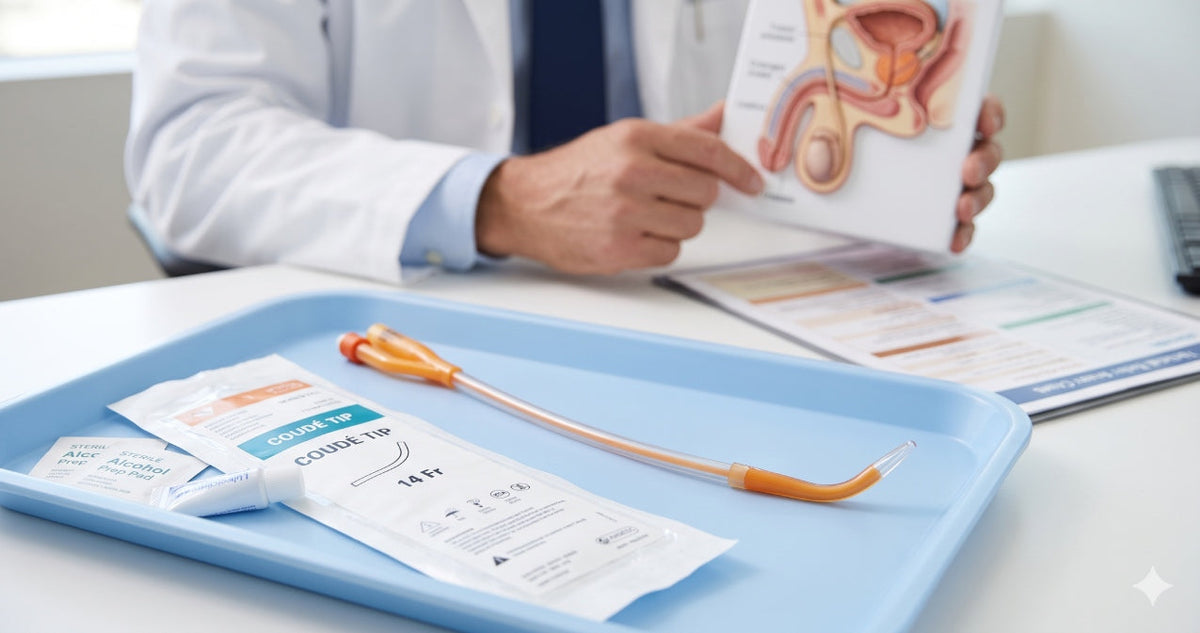
If you have been prescribed a coude catheter, the curved tip may be one more unfamiliar detail to understand. The difference is simple, but it has a specific purpose: most urinary catheters have a straight tip, while a coude catheter has a curved one. Knowing why that curve is used can help you understand your prescription and check that a reorder matches it.
What the curve is for
Coude comes from the French word for bent. The tip angles upward in a gentle curve over the last inch or so of the catheter.
In a straight urethra, a straight tip may pass without difficulty. Where the passage is narrowed or deflected, it can meet resistance at the point of obstruction. A curved tip can be oriented to follow the natural angle instead. For this reason, coude catheters are often used when an enlarged prostate, a stricture or scar tissue makes straight catheterisation difficult. The need for this type is determined clinically.
Tip variations
Not all curved tips are identical. A Tiemann tip is tapered and slightly flexible toward the end. An olive tip has a small rounded bulb at the point of the curve. A Coude-Councill tip includes an opening at the very end.
These differences affect how the catheter negotiates a particular obstruction. That is why a prescription usually names the specific tip type rather than leaving it open to substitution. Ordering a different curved tip because it is in stock is not a like-for-like swap, even if the packaging looks almost identical.
Orientation matters
The curve must point in the correct direction. During insertion, the tip is oriented upward to follow the urethral angle rather than press against it.
Manufacturers mark the top of the catheter so the direction of the curve remains visible once it is partly inserted, commonly with a stripe or raised line along the shaft. Anyone switching from a straight catheter to a coude should be shown the technique by a clinician rather than working it out independently.
Sizing
Catheter diameter is measured in French units, abbreviated Fr. One French equals one-third of a millimetre, so a 14 Fr catheter is roughly 4.7 mm across. Higher numbers mean wider catheters.
Length varies depending on whether the catheter is intended for male, female or paediatric use. Coude catheters are most commonly supplied in the longer male lengths. Both French size and length are specified clinically, and both appear on the packaging alongside the tip type.
What to check before ordering
Before reordering, match the French size, length, tip type, and whether the catheter is coated or uncoated. Hydrophilic and pre-lubricated coatings change how the catheter handles, so coated and uncoated versions of the same size are not interchangeable in practice. Confirm sterility and single-use labelling, and check pack quantity, since these are usually boxed.
For related supplies, see the intermittent catheters collection and the Bard Infection Control Urine Drainage Bag with Anti-Reflux Chamber, 2000 mL. You can also read about external catheters for men and understanding incontinence.
Catheter type, size and technique must be determined by a qualified healthcare provider. If you are reordering, our team can help match the product using the details printed on your existing packaging.
Medical disclaimer
This article is provided for general educational purposes only and does not constitute medical advice, diagnosis or treatment. Product information is general and may not suit every individual's circumstances. Always consult a qualified healthcare provider regarding your specific medical needs before changing any aspect of your care.
Published by the Online Medical Supply Team | onlinemedicalsupply.com
Questions? Call us at the number on your site's contact page or email the address on your site's contact page.